In the early 1900’s a young girl was facing the question, “Is God calling me to be a witness for him in a foreign land?” She believed that answer was, “Yes.”So, she went to college to learn how to best bring light to a dark and dying world. In college she was faced with another question. She had always had a desire to be married, but she wasn’t sure if thats what God had for her. “Is God calling me to be a single missionary?” She hoped not, but soon felt she must submit to the will of God in this area of her life as well. It was hard to do, but slowly she died to self, and surrendered her desires to God.
Shortly after she faced this question, God brought a young man to her who also had a call to a foreign land. He also was trying to die to his desire to have a wife. They liked each other, but knew it was not God’s time. They thought it unwise to build a relationship until they knew God’s will. Elizabeth – the young lady – soon graduated, a year before her friend, and started her journey as a young, single missionary while dying to desires that arose in her heart to marry this young man. They agreed not to even write one another until Jim, the young man, knew it was of God.
A few years passed and God did indeed approve of their relationship. After five years of waiting, Elizabeth Howard became the bride of Jim Elliot. After about a year and a half, Elizabeth was with child. They had a beautiful baby girl. God had led the couple to a remote village in Ecuador, South American. They had many challenging obstacles on their journey but God was helping them get through them. Jim and Elizabeth Elliot had been joined by several school friends and couples from the US. As many of you already know, these five men began to embark on a a path that would lead to their death.
They believed God wanted them to take the gospel to a savage tribe that had never heard of God’s love. They only knew the bondage of sin and enslavement to their own false gods. Sadly, after Jim and Elizabeth had been married for little over 2 years, Jim would never return to hold his wife or ten month old baby girl. He died a stranger in a foreign land.
Elizabeth, now a widow, would remain in Ecuador at the house Jim made and eventually would travel into the jungle to reach the very people who had killed her husband. She would later write a book, Suffering is Never for Nothing.
I cannot help but draw a parallel to a character in the Bible; one that saw much suffering in her life. Her story is found in the small book of Ruth.
Ruth 1:1-5 KJV
1 Now it came to pass in the days when the judges ruled, that there was a famine in the land. And a certain man of Beth-lehem-judah went to sojourn in the country of Moab, he, and his wife, and his two sons. 2 And the name of the man was Elimelech, and the name of his wife Naomi, and the name of his two sons Mahlon and Chilion, Ephrathites of Beth-lehem-judah. And they came into the country of Moab, and continued there. 3 And Elimelech Naomi’s husband died; and she was left, and her two sons. 4 And they took them wives of the women of Moab; the name of the one was Orpah, and the name of the other Ruth: and they dwelled there about ten years. 5 And Mahlon and Chilion died also both of them; and the woman was left of her two sons and her husband.
Here is a lady, following her husband -for good or bad. While she is a stranger in a foreign land, God allows her husband to die. Not only that, but God takes her sons away from her as well. Leaving her a widow and childless. I am sure that you know the story. Naomi was allowed to suffer greatly.
20 And she said unto them, Call me not Naomi, call me Mara: for the Almighty hath dealt very bitterly with me. 21 I went out full, and the Lord hath brought me home again empty: why then call ye me Naomi, seeing the Lord hath testified against me, and the Almighty hath afflicted me?
Did God allow this suffering against Naomi to testify against her? She certainly believed so. After all, what purpose could God have in afflicting her so. What about Elisabeth Elliot? Was God chastising her just because? Maybe because she was in the wrong Christian denomination? Maybe she missed God’s plan? Maybe she had doubts and fears that God was bringing upon her to judge her? Or, maybe God doesn’t only use sufferings and trials as a way to judge us. Maybe Naomi’s and Elizabeth Elliot’s experiences are not all that different from Christians today. Maybe God has a purpose in our suffering. Let’s look to 1st Peter to see what God says about trials.
1 Peter 1KJV
1 Peter, an apostle of Jesus Christ, to the strangers scattered throughout Pontus, Galatia, Cappadocia, Asia, and Bithynia,
2 Elect according to the foreknowledge of God the Father, through sanctification of the Spirit, unto obedience and sprinkling of the blood of Jesus Christ: Grace unto you, and peace, be multiplied.
3 Blessed be the God and Father of our Lord Jesus Christ, which according to his abundant mercy hath begotten us again unto a lively hope by the resurrection of Jesus Christ from the dead,
4 To an inheritance incorruptible, and undefiled, and that fadeth not away, reserved in heaven for you,
5 Who are kept by the power of God through faith unto salvation ready to be revealed in the last time.
6 Wherein ye greatly rejoice, though now for a season, if need be, ye are in heaviness through manifold temptations:
7 That the trial of your faith, being much more precious than of gold that perisheth, though it be tried with fire, might be found unto praise and honour and glory at the appearing of Jesus Christ:
8 Whom having not seen, ye love; in whom, though now ye see him not, yet believing, ye rejoice with joy unspeakable and full of glory:
9 Receiving the end of your faith, even the salvation of your souls.
There is so much going on in 1 Peter 1, more than I can cover here. I want to point out a few things, though: Peter is talking to a group of people he calls “Strangers”. This is not because he does not know them. He may, or may not know these people personally, but his point in calling them strangers is to identify their condition. They have become estranged to their homes and possibly forced to move because of their belief in Jesus. This word means that they are foreigners.
This term is linked to suffering. It is a trial that these people are enduring, not because they have done something wrong but, because they are following Christ. Its first used to describe what would happen to the nation of Israel in Egypt.
Genesis 15:13-14
13 And he said unto Abram, Know of a surety that thy seed shall be a stranger in a land that is not theirs, and shall serve them; and they shall afflict them four hundred years;14 And also that nation, whom they shall serve, will I judge: and afterward shall they come out with great substance.
So Peter identifies these people as strangers, and in doing so he links them to suffering – to trials. He says they are in “heaviness”. This is that heaviness of heart and mind that we experience in the midst of difficulty. The heaviness that Naomi had when she returned empty. He also implies they are going through “manifold temptations”. Manifold simply means many and diverse. The temptations spoken of here are trials or tests. Simply put, these strangers are going through many different types of sufferings.
Peter, though does not talk to one as if he is trying to console a widow. He uses words like “rejoice”, “joy unspeakable”, and “greatly rejoice.” He says, their trials are precious, like Gold. How can Peter address these people that are suffering and use words like this? What is trying to be conveyed? It is unmistakable that Peter is trying to help these strangers get in the right state of mind about the trials they are going through. Peter wants these strangers to understand what trials will produce in their lives, so that they rejoice in their sufferings. In the same way, God desires for us to understand that suffering has a purpose and should produce spiritual fruit so that we can rejoice in the midst of our trials. I see three specific results or products that God is after from our text.
- Praise, Honor, and Glory
Trials should produce praise, honor, and glory at the appearances of Jesus. This is somewhat directed at us as believers in Christ. We will be praised by God for our faithfulness to him with words like, “Well done my good and faithful servant…” We will also share in God’s glory at the end. But this verse must also mean that we are giving – or causing others to give – praise and honor and glory to God when we have the right attitude in the midst of our suffering. I would like to call this product worship. Trials should produce true worship. Worship is bowing down before in honor, giving praises with a thankful heart so that the object of worship receives glory by the one bowing and those that are witnessing it. Naomi failed this test at first, her heart was heavy and everyone knew her struggle. But, she endured through the trial and God brought joy and in the end she worshipped.
Ruth 4:14-16 KJV
14 And the women said unto Naomi, Blessed be the Lord, which hath not left thee this day without a kinsman, that his name may be famous in Israel.15 And he shall be unto thee a restorer of thy life, and a nourisher of thine old age: for thy daughter in law, which loveth thee, which is better to thee than seven sons, hath born him.
16 And Naomi took the child, and laid it in her bosom, and became nurse unto it.
Not only did Naomi rejoice in God’s goodness, the suffering that God allowed Naomi to go through produced praise in the women that witness the redemption of God. God’s redeeming love should be enough to cause us to worship him no matter what the circumstances.
That brings us nicely to the 2nd product God desires out of suffering:
2. An Eternal Mindset
Peter is constantly reminding the strangers of their reality in Christ. In the very first sentence he reminds them that they are “Elect according to the foreknowledge of God the Father, through sanctification of the Spirit, unto obedience and sprinkling of the blood of Jesus Christ…” Elect means called or chosen. What are these strangers called to? They are called to two things; obedience – as servants of Christ- and sprinkling – a picture of having been cleansed and set apart for God’s use (see Hebrews 9). He reminds us that God has “Begotten us again [born again] unto a lively hope by the resurrection of Jesus Christ from the dead.” That we have an eternal inheritance that is “incorruptible, and undefiled, and that fadeth not away, reserved in heaven for you.” He says we should rejoice because we are receiving the end of our faith, “even the salvation of your souls.” Trials should cause us to think eternally. He even gos on to talk about how great a mystery our salvation is to the Old Testament prophets and the angels.
1 Peter 1KJV
10 Of which salvation the prophets have enquired and searched diligently, who prophesied of the grace that should come unto you:11 Searching what, or what manner of time the Spirit of Christ which was in them did signify, when it testified beforehand the sufferings of Christ, and the glory that should follow.
12 Unto whom it was revealed, that not unto themselves, but unto us they did minister the things, which are now reported unto you by them that have preached the gospel unto you with the Holy Ghost sent down from heaven; which things the angels desire to look into.
13 Wherefore gird up the loins of your mind, be sober, and hope to the end for the grace that is to be brought unto you at the revelation of Jesus Christ;
14 As obedient children, not fashioning yourselves according to the former lusts in your ignorance:
15 But as he which hath called you is holy, so be ye holy in all manner of conversation;
16 Because it is written, Be ye holy; for I am holy.
17 And if ye call on the Father, who without respect of persons judgeth according to every man’s work, pass the time of your sojourning here in fear:
18 Forasmuch as ye know that ye were not redeemed with corruptible things, as silver and gold, from your vain conversation received by tradition from your fathers;
19 But with the precious blood of Christ, as of a lamb without blemish and without spot:
20 Who verily was foreordained before the foundation of the world, but was manifest in these last times for you,
21 Who by him do believe in God, that raised him up from the dead, and gave him glory; that your faith and hope might be in God.
22 Seeing ye have purified your souls in obeying the truth through the Spirit unto unfeigned love of the brethren, see that ye love one another with a pure heart fervently:
23 Being born again, not of corruptible seed, but of incorruptible, by the word of God, which liveth and abideth for ever.
24 For all flesh is as grass, and all the glory of man as the flower of grass. The grass withereth, and the flower thereof falleth away:
25 But the word of the Lord endureth for ever. And this is the word which by the gospel is preached unto you.
Our trials have a conclusion, Our bodies have end, just as all natural things wither, fade, and die. But God has redeemed us [bought us back] not with money or that which is going to fade. He bought us with His very precious eternal blood. Peter encourages these strangers to have an eternal mindset.
In the book of Job, there is a very odd but wonderful break in the sad narrative. Job has been afflicted in every way possible, and that with the permission of God. His friends are chastising him but Job turns his eyes upwards.
JOB 19:23-27 KJV
23 Oh that my words were now written!…25 For I know that my redeemer liveth, and that he shall stand at the latter day upon the earth:
26 And though after my skin worms destroy this body, yet in my flesh shall I see God:
27 Whom I shall see for myself, and mine eyes shall behold, and not another; though my reins be consumed within me.
It is God’s desire that when we are going through trails, we look to the things that are eternal.
3. A Physical Closeness To Christ
The third product that God desires sufferings to bring forth in our lives is a physical closeness to Christ. It is in suffering that we experience the sweet fellowship with God. It is this that we, as Christ followers are called to. We are called to suffer. He has told us to take up our cross daily and follow him (Luke 9:23).
1 Peter 2:21-25
21 For even hereunto were ye called: because Christ also suffered for us, leaving us an example, that ye should follow his steps:22 Who did no sin, neither was guile found in his mouth:
23 Who, when he was reviled, reviled not again; when he suffered, he threatened not; but committed himself to him that judgeth righteously:
24 Who his own self bare our sins in his own body on the tree, that we, being dead to sins, should live unto righteousness: by whose stripes ye were healed.
25 For ye were as sheep going astray; but are now returned unto the Shepherd and Bishop of your souls.
The trials of our faith connect us to Christ and His suffering. This is what baptism is about; it is a picture of Christ’s death, burial, and resurrection; and our willingness to follow by our death, burial, and resurrection. We are called to die to self, and live for God. This will bring suffering. When we suffer for well doing, or even in the normal aspects of our lives, God is desiring us to get close to Him and to be a partaker of His suffering.
1 Peter 4:12-13 KJV
12 Beloved, think it not strange concerning the fiery trial which is to try you, as though some strange thing happened unto you:13 But rejoice, inasmuch as ye are partakers of Christ’s sufferings; that, when his glory shall be revealed, ye may be glad also with exceeding joy.
This is what the Last Supper was all about. We drink of the cup of suffering, His blood. We eat of His body, the bread that was broken for us. We become partaker in His suffering. I must say, this is completely symbolic. The disciples ate literal bread and drank literal wine – unfermented in my biblically based opinion – and it is a great blasphemy that the papists take part of this – so called – transubstantiation. Christ also washed Peter and other disciples’ feet and told them to do likewise.
We are called to be fellow suffers with Christ, but it is He that suffered for us first. He tasted death for all men. God desires for us to understand that suffering has a purpose and should produce a spirit of worship, an eternal mindset, and a physical closeness to Christ so that we can rejoice in Christ through the midst of our trials.
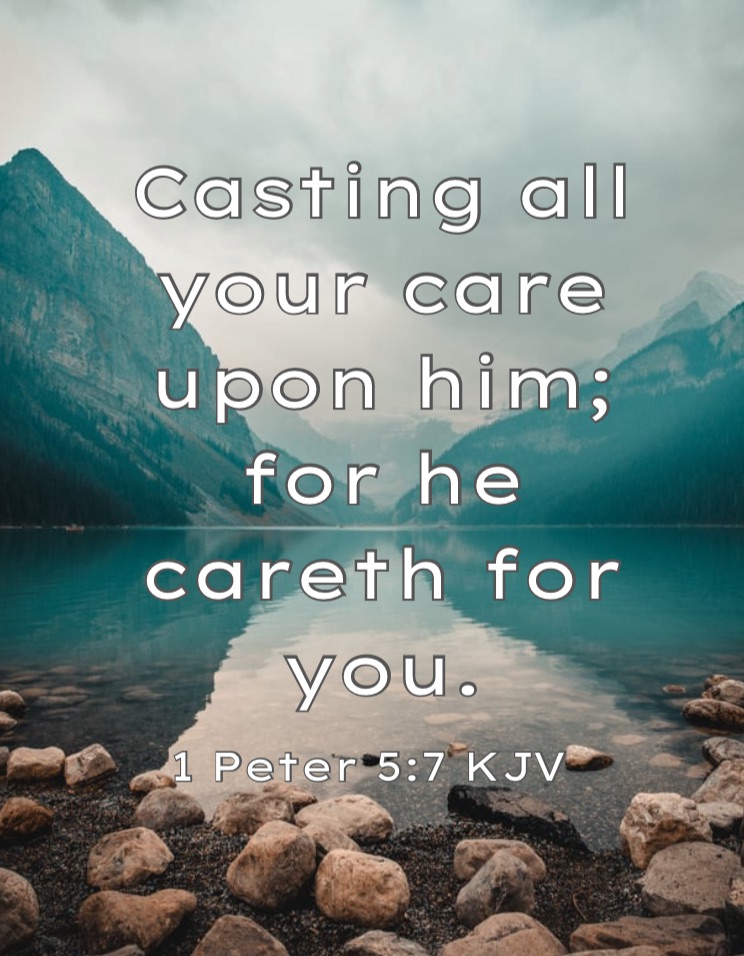
I Peter 5:7 “Casting all your care upon him; for he careth for you.”
S. T.
Acts 20:24
"None of theses things move me..."
 wonderfullymadepublication.com